Seven-thirty in the morning at a medical lab in Nasr City. The blood-draw queue stretches to the door. The receptionist writes each patient's name on a sheet, sticks a handwritten label on every tube, then flips through a notebook of contracts to find the price for an employee of one of the companies the lab works with. Inside, the chemistry analyzer prints its results on a paper strip, and a technician types them, number by number, into a Word template while the lab specialist waits to review and sign. At the same moment a courier arrives with a box of samples from the Heliopolis branch, along with a handwritten list of names that does not quite match the number of tubes.
In the afternoon a patient calls about a result, and a staff member scrolls the branch WhatsApp group for a photo of the report. A referring doctor asks why the result never reached him. At the end of the shift the drawer does not match the receipts, and the manager finds a box of reagents that expired before anyone opened it.
This scene repeats in independent labs and in lab chains with branches and collection points across Heliopolis, Maadi, Alexandria and Mansoura. The cause is not a weak team. A lab handles a large volume of samples every day, and each one has to stay tied to its patient, its result and its invoice without a single mix-up. This is a practical guide to choosing a laboratory management system in Egypt: what it does, every module, integrations, privacy, ready-made versus custom, cost factors and the first ninety days. If you want the bigger picture of medical systems first, start with our guide to the clinic management system in Egypt. At Jad Digital (جاد للتطوير الرقمي), a Cairo software house building custom business and healthcare systems since 2019 for clients in Egypt and Saudi Arabia, we will also tell you plainly when a ready-made product is the smarter choice.
The short answer
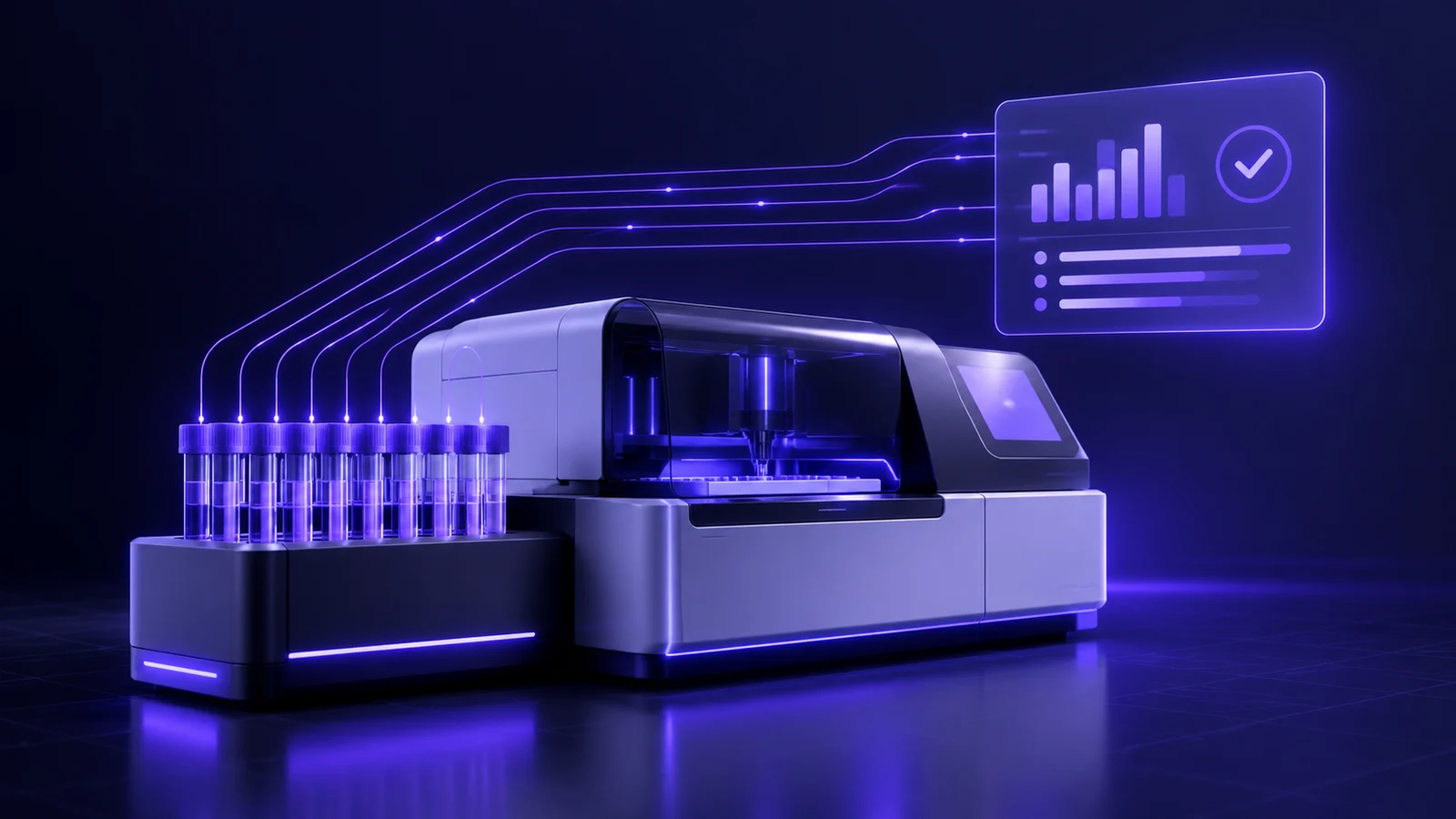
A laboratory management system, often called a lab information system (LIS), is software that runs a sample's entire journey in one place: patient registration and test orders, barcode labels and collection, transfer between branches, receiving results from analyzers, review and validation, and finally issuing, delivering and billing the report.
- A laboratory management system gives every sample a unique barcode linked to the patient, the visit and the tests ordered, which reduces the risk of sample mix-ups.
- Analyzer interfacing means the lab analyzer sends results straight into the patient's visit record instead of a staff member typing them by hand.
- Lab results are usually released through two-step validation: a technician enters or confirms the result, then a lab specialist reviews and signs it before the report leaves the lab.
- A lab information system does not interpret results medically; it displays values against the reference ranges the lab configures, and medical decisions stay with the specialist and the treating doctor.
- Lab chains need branches, collection points, documented sample transfers and contracts with companies, insurers and referring doctors, each with its own price list.
- Electronic report delivery typically combines a PDF, a link sent by WhatsApp or SMS, a patient portal and a QR code that lets anyone verify the report is authentic.
Signs your lab has outgrown paper, Excel and WhatsApp
A lab needs a proper system when these symptoms appear, and they usually appear together:
- Handwritten labels. A patient's name is written on the tube, another patient with a similar name stands in the same queue, and the fear of a swapped sample never goes away.
- Results typed twice. The analyzer prints a result, a technician retypes it into the report template, and every retyping is a chance for error.
- Nobody knows where a sample is right now. Was it drawn? Did it arrive from the collection point? Has it gone into the analyzer? Is it waiting for a re-draw? The answer comes from a phone call, not a screen.
- Reports travel on personal WhatsApp. Photos of reports are sent from staff phones, so the lab's history of patient results lives on devices the lab does not own.
- Contracts in a notebook. Company rates, insurer rules and referring-doctor arrangements sit in a ledger or a spreadsheet, and every employee calculates them differently.
- Reagents expiring on the shelf. Stock levels are only known at stock-take, with no warning before an expiry date or before an item runs out.
- Shift closing that never balances. The drawer is off, discounts are undocumented, and nobody knows who voided a receipt.
What makes a medical lab different from other healthcare businesses
A lab differs from a clinic because its basic unit of work is not the appointment. It is the sample. The patient leaves within minutes and the sample's journey begins: one or more tubes per visit, each with its own type and storage conditions, moving through departments, perhaps to a central lab or an external reference lab.
That forces any lab information system in Egypt to handle four things that generic systems do not understand:
This is why generic clinic or accounting software breaks quickly inside a lab. It is also why radiology centers need different logic from labs even though both are "diagnostics", as we explain in our guide to the radiology center management system in Egypt.
- Tracking at tube level: it is not enough to know that a patient ordered a complete blood count and liver function tests. The system must know which tube serves which test and where that tube is now.
- Receiving data from analyzers: results are produced by instruments with their own software and connection methods, and a good system receives them instead of relying on manual entry.
- Reference ranges that vary: the normal range printed on a report may differ by age, sex and method, and the lab itself sets it.
- Accountable validation: no report goes out until a responsible specialist reviews it, and the system must record who reviewed, who validated and when.
Message us on WhatsApp or book a free consultation — we answer plainly, with no obligation.
The modules of a laboratory management system, one by one
These are the modules a serious lab system is built on. You do not need all of them on day one, but the design must be ready for them.
Patient registration and opening a visit
Every journey begins with a fast reception screen: search for the patient by mobile number or national ID, or register a new patient with name, age, sex and contact details. Then a visit is opened, tests are selected from the catalog or from packages, and the payer is set: cash, a contracted company, an insurer or a referring doctor. A photo of the doctor's request can be attached, along with reception notes such as fasting status or medications the patient mentioned, recorded as stated without interpretation.
The screen has to be fast during the morning rush, suggesting common tests and packages and pricing the visit instantly by payer.
Barcode labels and chain of custody
As soon as the visit is saved, the system prints a barcode label for every required tube, showing the patient's name, the visit number, the tube type and the department. The question "whose tube is this?" becomes a single scan.
Then the chain of custody is recorded: who drew the sample and when, when it was dispatched and with whom, when the department received it, and when it went into the analyzer. Each barcode scan adds a line to the sample's history. If a sample is rejected because it is insufficient or for another technical reason, the system records the reason, opens a re-draw request and alerts reception to contact the patient.
Test catalog, panels and reference ranges
The catalog is the backbone. Every test has a standardized name in Arabic and English, a department, a specimen and tube type, a unit of measurement, a usual turnaround time and a price on each price list. Composite tests are defined as a group of parameters that appear together on the report. Packages bundle several tests under one price for promotions or corporate check-ups.
Reference ranges are configured per test by age and sex, sometimes by analyzer or method, and they are set by the lab's specialists, not by the software company. The system's role is purely mechanical: it prints the right range for each patient, flags values outside it, and alerts the specialist to critical values that the lab has defined so they can be handled according to the lab's own policy. Interpretation and medical decisions always remain with the specialist and the treating doctor.
Analyzer interfacing
Connecting analyzers is the biggest difference between a real lab system and generic software. The mechanism works like this: the system sends the analyzer a worklist of pending samples by barcode, the analyzer reads the barcode on the tube and knows which tests to run, then sends the results back to the system, where they appear in the visit record with no typing. Some instruments connect one way only, sending results without receiving the worklist; others connect in both directions.
The connection may be a serial port, a network link or exported result files, usually through established laboratory data-exchange protocols, sometimes via middleware. So give any software company the list of your analyzers by model, ask what they have actually connected before, and request a live test on a real device before you rely on a promise.
Result entry and two-step validation
Not every result comes from an analyzer; some microbiology or microscopy work is read manually. So the system needs entry screens for numeric values, predefined choices and descriptive text templates.
Then comes two-step validation. The technician enters a result or confirms what arrived from the analyzer, and the lab specialist reviews and validates it. The system records both names and timestamps, blocks the report from leaving before validation, and keeps any post-validation change together with its reason. The specialist can see the same patient's previous results beside the current one, because comparison is part of a proper review.
Report generation and delivery
After validation the system generates the report in the lab's template: logo, patient and referring-doctor details, results grouped by department, reference ranges and the specialist's signature. Then it is delivered in more than one way:
A copy can also go to the referring doctor when the patient agrees. To see how these results become part of a patient's record inside a clinic, read our guide to the electronic medical record in Egypt.
- A PDF printed at the counter or sent digitally.
- A link by WhatsApp or SMS sent automatically on validation, opening the report after a simple check such as a code or part of the patient's details.
- A patient portal where patients see all their past reports, often part of the lab's website or app.
- A QR code on the printed report that opens the original copy on the lab's server, so any third party can confirm the report has not been altered.
Home sample collection scheduling
Home collection has become a core service for many labs. The module starts with a request by phone, WhatsApp or the website: address, tests and preferred time. A supervisor assigns requests to collection staff by area and time slot. Each nurse or phlebotomist sees their visits and addresses in a simple mobile app, labels the tubes at the patient's home, records payment, and hands the samples to the lab with a scan that closes the loop.
No request gets lost between a phone call and a scrap of paper. The booking and reminder logic is close to what we describe in our guide to the clinic appointment booking system.
Branches, collection points and sample transfer
Lab chains usually run full branches plus small collection points that gather samples and send them to a central lab. Here the system needs transfer manifests: the collection point builds a shipment by scanning barcodes, prints the manifest, and the central lab receives it by scanning every tube, so any missing or extra sample shows up immediately.
The system also knows which tests run at which branch and which are routed to the central or an external lab. The manager sees every branch on one screen; each branch sees only its own data.
Contracts with companies, insurers and referring doctors
A large share of a lab's work arrives through contracts. This module manages multiple price lists: a general list, a list per contracted company and a list per insurer, with rules such as the patient's share, tests that need prior approval, and coverage limits. The system then splits each invoice between the patient's share and the payer's share and compiles a periodic statement for each payer to support the claim.
For referring doctors, the system records who referred each case, applies whatever arrangement management has defined, and produces a periodic report of referred cases. This module in particular needs a written policy before development starts, because the rules vary from one lab to another.
Reagents and consumables inventory with expiry
Reagents, controls, tubes and consumables are a real cost, and many carry a lot number, an expiry date and storage conditions. The module records receipts by lot and expiry, issues stock to departments, warns before expiry and at reorder level, and tracks stock per branch.
Linking consumption to tests performed reveals waste. The lot and expiry logic is similar to what we cover in our guide to the pharmacy management system in Egypt.
Cashier, shift closing and accounting
Every visit ends with a receipt: cash, card, mobile wallet, or credit to a contracted payer. The system records every payment against the employee and the shift, requires permission for any discount or void, and produces an end-of-shift closing split by payment method that the manager compares with the actual drawer.
Revenue, receivables from payers and expenses then flow into accounting, either inside the same platform or through a connection to the accountant's software.
Quality-control logs
Serious labs keep daily quality records: control results for each analyzer before runs, calibrations, maintenance, refrigerator temperatures, and corrective actions whenever something goes wrong. This module makes those records digital, dated and tied to the instrument and the user, and plots control results on a timeline that the quality specialist reviews according to the rules the lab defines.
During any audit or accreditation request, the records are complete and exportable. Confirm current licensing and accreditation requirements with the official authority.
Management reports
A lab manager needs a small set of reports every day or week:
- Visits and tests per branch and department.
- Samples past their usual turnaround time, and rejected samples with reasons.
- Revenue by payer, and receivables from companies and insurers.
- Home-collection performance per staff member.
- Reagents near expiry or at reorder level.
- Shift-closing differences, discounts and voids.
Integrating a laboratory management system with other systems
Integration is what turns lab software from a standalone screen into part of the business, and it usually covers:
- Accounting: moving revenue, receivables and expenses into the accounting system. We compared the options in ready-made accounting software vs a custom system.
- E-invoicing and e-receipts: if your activity is required to issue electronic documents, the mechanism is that the system generates the document with the required data, submits it to the Egyptian Tax Authority platform through the approved integration, and stores the acceptance ID or rejection reason. We explain this in connecting your system to ETA e-invoicing in Egypt. Confirm current requirements with the official authority or your accountant.
- WhatsApp and SMS: sending report links and home-collection reminders from the lab's official number through a business messaging service, with approved templates and respect for patient consent.
- Online payment: payment links for home collection or the portal, with payments posted to the visit automatically.
- Clinics and medical centers: receiving test orders from a contracted clinic or center and returning results to the patient's record there, as described in our guide to the medical center management system in Egypt.
- Website and app: home-collection booking and a results portal under the lab's own brand.
Patient data privacy and permissions
Lab results are among the most sensitive health data a business can hold, so privacy has to be built in from the start:
These are technical mechanisms. For the current legal requirements on personal and health data protection in Egypt, confirm current requirements with the official authority and consult a specialized lawyer before launch.
- Role-based permissions: reception sees the visit and the invoice but not results, technicians see their department's samples, specialists validate, and the accountant sees figures without results.
- Audit log: who opened any patient's report, who changed a result after validation and why, who granted a discount or voided a receipt.
- Protected report links that expire or require verification, rather than photos passed between phones.
- Automatic backups at least daily, with an actual restore test, not just the existence of a backup.
- Known hosting location for the owner, with the right to receive a full copy of the data if you change vendors.
Ready-made lab software or a custom system?
The honest answer is that not every lab needs a custom system. We discuss the general logic of this decision in custom ERP vs off-the-shelf.
When ready-made software is enough
In that situation, the smarter move is to start with ready-made software and save your time.
- A single lab with no branches or collection points.
- A limited number of analyzers that the ready-made product genuinely supports.
- Few contracts with simple rules.
- The product offers an acceptable Arabic and English report and electronic result delivery.
When a custom system pays off
- A chain of branches and collection points with a central lab and sample transfers.
- Many contracts with companies, insurers and doctors under different rules.
- A large home-collection operation that needs a staff app and area-based dispatching.
- Analyzers or middleware that the ready-made product does not support.
- A wish for a patient portal and app under the lab's brand, connected to the same system.
The middle path
Many labs start with ready-made software for registration and results, then build what is missing around it: a home-collection app, a results portal, a contracts dashboard or management reports. The condition is that the ready-made product offers an API or structured export. When you outgrow that, a full system can be built through our ERP and business systems service.
What determines the cost of a laboratory management system?
The cost of a laboratory management system is driven by a set of factors rather than a fixed figure:
The right way to get a number is to define these factors with the software company in a discovery session, then ask for a proposal split into phases.
- Number of modules in the first phase and what can wait.
- Number and types of analyzers, how each one connects, and whether middleware is involved.
- Number of branches and collection points and the sample-transfer logic between them.
- Contract complexity: price lists, patient-share rules and approvals.
- Delivery channels: PDF only, or links and WhatsApp, or a patient portal and app.
- Home collection and whether it needs a staff app.
- Data migration from the current system and the size of the results archive.
- Integrations with accounting, e-invoicing and payments.
- Hosting and support after launch.
Rollout: the first 30, 60 and 90 days
First 30 days
Map the sample journey on one page with reception, technicians and the specialist: registration, barcode, collection, transfer, analyzer, validation, delivery. Prepare the test catalog with standardized names, reference ranges and price lists. Then switch on registration, barcodes, receipts and report generation in one branch.
First 60 days
Connect analyzers one at a time, starting with the busiest, and compare its results in the system with the printout for a period. Activate two-step validation and report links, then add contracts and price lists.
First 90 days
Extend to branches, collection points and transfer manifests, and switch on home collection, reagent inventory and quality logs. Review management reports weekly and gather team feedback for an improvement round.
Checklist to prepare before your first meeting with any software company
The more of this you prepare, the sharper the meeting and the more realistic the proposal. For more depth, see our guide on how to write a software project brief.
- Your current test catalog with names, departments and specimen type per test.
- A list of analyzers by model, and how their results come out today.
- Number of branches and collection points, and which tests run where.
- Price lists, the list of contracts and each payer's rules.
- A sample of your current report template.
- How home collection works today and how many staff do it.
- How results are delivered today: paper, WhatsApp, email.
- The quality records you currently keep.
- How shifts are closed and which software your accountant uses.
- The reports you want to see every morning.
How Jad Digital builds a laboratory management system
We start with a discovery session with the manager, reception and the lab specialist, and we follow a real sample from the queue to the report. Then we prioritize modules, review your analyzer list before promising any integration, and tell you plainly whether a ready-made product covers your needs.
We deliver in short phases with Arabic and English interfaces, test the report template and the validation flow with your specialist before go-live, train each role on its own screens, and stay on for support after launch. If the lab needs a patient portal or app, we build it connected to the same system. For the full picture of healthcare systems, go back to our clinic management system guide.
If you run a lab or a lab chain and feel that paper and WhatsApp are no longer enough, book a free consultation. We will listen, map the sample journey with you, and tell you honestly which option fits.
Frequently Asked Questions
What is a laboratory management system?
+
A laboratory management system, or lab information system (LIS), is software that runs a lab's operations in one place: patient registration, barcode labels, sample tracking, receiving results from analyzers, validation, report delivery, contracts, inventory and accounting. It replaces handwritten labels, typed templates and WhatsApp photos with a single auditable record.
What is the best laboratory management system in Egypt?
+
The best system is the one that fits your lab's size, analyzers and contracts, not a single product that suits everyone. A single lab is often well served by ready-made software that supports its instruments, while a chain with branches, collection points and many contracts may get more from a custom system. Test any product with your own analyzers and reports before signing.
Can lab analyzers send results to the system instead of staff typing them?
+
Yes, for most modern analyzers. The analyzer reads the tube's barcode and sends the result straight into the visit record. The connection method depends on the device and its software, so ask for a live test on your exact model before relying on any promise.
Does lab software interpret results for patients?
+
No. The system is an operational tool: it shows each value against the reference range the lab configures and flags values outside it. Interpretation and medical decisions remain with the lab specialist and the treating doctor.
How can a lab send results to patients on WhatsApp securely?
+
The best approach is for the system to send a protected link automatically from the lab's official number through a business messaging service once the report is validated, not a photo from a staff phone. The link opens the report after a simple check, and the report can carry a QR code to verify its authenticity.
Which company in Egypt can build a lab information system for a chain of branches?
+
Look for a software company that has built multi-branch business systems, asks for your analyzer list before promising integration, and can design branches, collection points and barcode-based sample transfers. At Jad Digital we start with a free discovery session to map your sample journey before proposing anything.
How much does a laboratory management system cost?
+
Cost depends on factors such as the number of modules, the analyzers to integrate, branches, contracts, result-delivery channels, home collection and data migration. Book a free consultation so we can define these factors with you and propose a phased plan that fits your budget.
How long does it take to implement a system in a medical lab?
+
It depends on the lab's size and the number of analyzers and branches. Usually registration, barcodes and reports go live in the first month, then analyzer integration and contracts, then branches, home collection and inventory over the following months. We set the timeline after the free discovery session.