Six in the morning at a food distributor's warehouse in the Obour industrial zone. The dispatch manager stands in front of a whiteboard covered in plate numbers and driver names, writing today's routes by hand: one van to Nasr City, two trucks to Qalyubia, a third to customers in Sharqia. One driver calls to say his van will not start because the battery is dead. Another sends a WhatsApp photo of a flat tyre. Someone in admin discovers, by pure chance, that the licence of one of the trucks expired two weeks ago, and it has been on the road every single day since. Meanwhile a customer in Banha calls to ask where his delivery is, and the dispatch manager rings the driver three times before he picks up.
At month end the finance manager stares at the fuel card statement and workshop invoices, trying to understand why one van burned more fuel than its twin on the same route. Nobody knows, because the data lives in a dispatch notebook, on drivers' phones and in a spreadsheet.
This scene is familiar across FMCG distributors in Obour, 10th of Ramadan and 6th of October City, contractors, courier companies in Cairo and Alexandria, and schools running buses. The common thread: the fleet has grown too big to run from a whiteboard and a phone.
This guide explains a fleet management system in Egypt from the owner's side of the desk: which modules you actually need, how they connect to the rest of your systems, when a ready-made product is enough, and what drives the cost. If your company is a courier or logistics business at its core, start with the wider picture in our guide to a shipping company management system in Egypt, then come back here for the fleet itself. At Jad Digital (جاد للتطوير الرقمي), a Cairo software house building custom business systems, operations dashboards and mobile apps since 2019 for clients in Egypt and Saudi Arabia, we will also tell you plainly when off-the-shelf software is the smarter choice.
The short answer
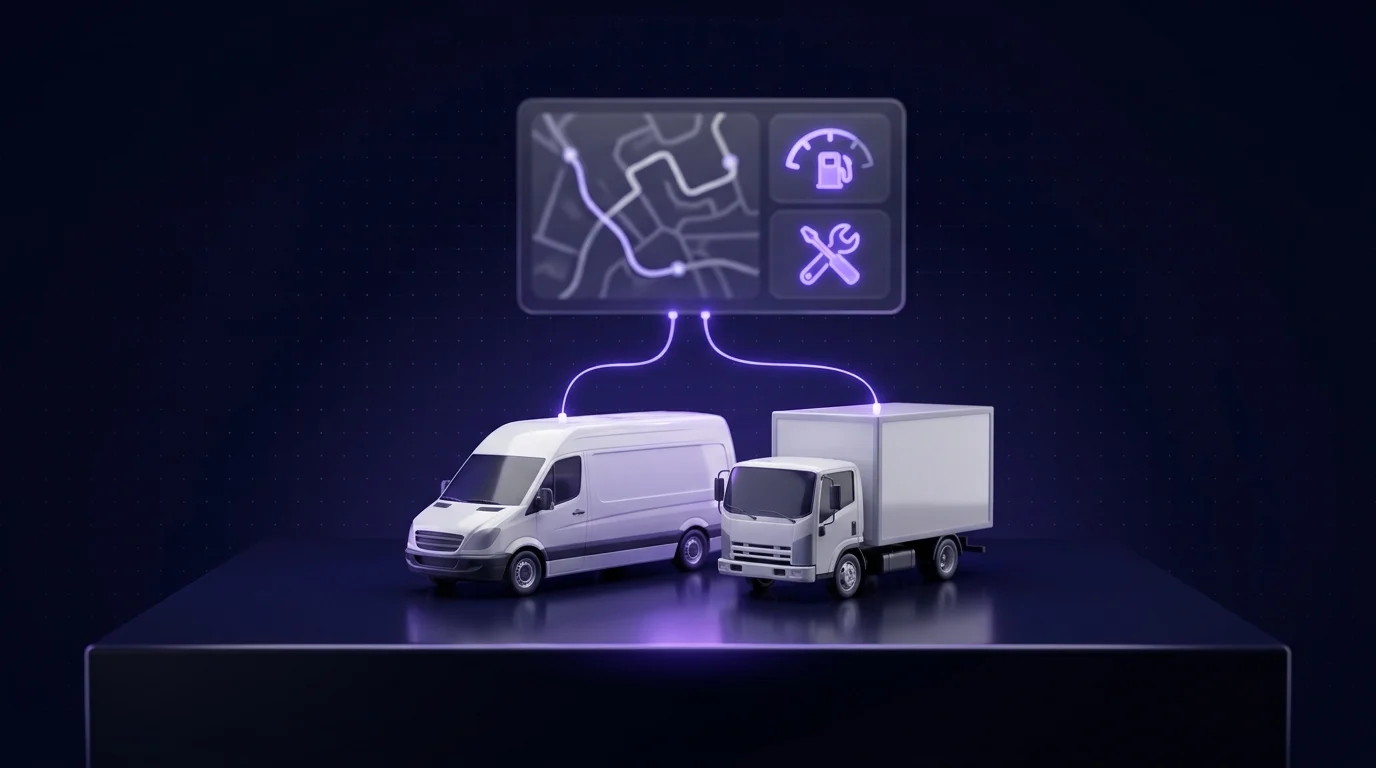
A fleet management system is software that brings everything about a company's vehicles and drivers into one place — vehicle records and documents, driver assignments, trips and routes, live location, fuel, maintenance, violations and accidents — and turns it into the real cost of each vehicle and each trip.
- A fleet management system sends alerts before vehicle licences, insurance policies and driving licences expire, instead of the company discovering the expiry after the fact.
- Company vehicle tracking works either through a GPS device installed in the vehicle or through a driver app that sends the phone's location to the system at regular intervals.
- Fleet management software compares each vehicle's fuel consumption against the distance it actually travelled, so abnormal consumption shows up in a report rather than disappearing inside a fuel card statement.
- Preventive maintenance in a fleet system is scheduled by odometer reading or by elapsed time, and every workshop visit opens a job card recording the parts and labour used.
- A driver app in a fleet management system captures the odometer reading, the daily vehicle checklist, vehicle photos and proof of delivery directly from the driver's phone.
- A cost-per-vehicle report combines fuel, maintenance, tyres, insurance, violations and depreciation, and it is the basis for deciding whether to repair a vehicle, replace it or outsource that route.
Signs your fleet has outgrown Excel and WhatsApp
Your company needs a fleet management system when these symptoms keep recurring, and they usually appear together once the fleet passes a handful of vehicles:
- Documents expire without anyone noticing. A vehicle licence, insurance policy or driver's licence lapses while the vehicle keeps working daily.
- "Where is the van right now?" requires a phone call. Nobody knows a vehicle's location unless the driver answers, and the customer keeps waiting.
- The fuel statement cannot be audited. The totals are known, but nobody can tie them to the kilometres each vehicle actually drove.
- Maintenance happens after breakdowns, not before. A truck reaches the workshop only when it stops on the ring road.
- Tyres and spare parts have no history. Nobody is sure which vehicle the last new tyre went on.
- Traffic violations surface late. A violation appears at renewal time and nobody knows who was driving that day.
- Cost per vehicle is unknown. Replacement decisions are guesswork.
- The driver is the database. Routes, customer timings and vehicle problems live in the driver's memory and phone, and they leave the company when he does.
What makes fleet management different from other business systems
Fleet management is different because the asset you manage moves all day outside your premises, consumes cost with every kilometre and is subject to official documents with expiry dates. A standard accounting or inventory system knows suppliers, items and invoices, but it does not know odometer readings, which driver was responsible at a given hour, or where a vehicle stopped.
That forces any fleet management software to handle four things:
This is why generic tools break quickly. A tracking-only platform shows dots on a map but knows nothing about cost; an accounting-only package knows the cost but nothing about the vehicle. A good fleet management system connects the two. We saw the same logic in manufacturing, where each machine has to be tied to its cost, as explained in our guide to a factory management system in Egypt.
- A three-way link between vehicle, driver and time. Every fuel fill, violation or accident belongs to one vehicle, one driver and one moment.
- Field work without a desk. Drivers enter data from a phone in a few taps, often with weak coverage.
- Cost that accumulates rather than one invoice. Fuel, servicing, tyres and insurance only reveal a vehicle's cost when gathered in one place.
- Very different operating patterns. A distribution fleet runs fixed routes to repeat customers; a delivery fleet handles orders that change hourly; a contractor's fleet moves equipment and crews between sites; school buses run fixed morning and afternoon routes with parents waiting for updates.
Message us on WhatsApp or book a free consultation — we answer plainly, with no obligation.
Fleet management system modules in Egypt, one by one
These are the modules a complete fleet management system is built on. You do not have to switch them all on from day one, but the design must be ready for them.
Vehicle registry, documents and renewal alerts
Every vehicle gets a full record: plate number, make, model and year, chassis and engine numbers, fuel type, capacity or payload, purchase date or lease start, the branch or project it belongs to, and its status — active, in the workshop, parked, or sold.
Scans of documents are attached to the record: vehicle licence, insurance policy and any activity-specific permits, each with its expiry date. The first benefit is immediate: an alert before any document expires, sent in the system and by email or WhatsApp, plus a morning list of everything expiring soon. For official renewal procedures, confirm current requirements with the official authority; the system organises reminders, it does not replace that.
Driver profiles and assignments
Each driver has a profile: personal details, driving licence class and expiry date, the vehicles he is allowed to drive, branch, and history of past assignments. This is where the idea of an assignment matters: who is responsible for this vehicle today or this week? Once assignments are recorded with date and time, you can always tell who was driving at the moment of any later event.
The profile also supports fair performance tracking (completed trips, checklist adherence, attributed accidents and violations), provided the rules are announced to drivers in advance.
Trips, routes and dispatch
This module is the working day itself. The dispatch manager creates trips: vehicle, driver, ordered stops, the customer or site at each stop, and the load. Distribution companies usually run fixed or near-fixed routes, so a route is saved as a template and repeated; delivery companies build trips from orders arriving every hour.
The dispatch board shows which vehicles are available, busy or in the workshop, and each trip moves through statuses: scheduled, started, on the road, completed, or failed with a reason. If your orders come from end customers through an app, you may need a full delivery app on top of this, which we cover in our guide to delivery app development in Egypt.
Company vehicle tracking and GPS device integration
Tracking works through one of two mechanisms, or both. The first is a GPS tracker installed in the vehicle that sends location, speed and engine status at regular intervals to the device provider's platform; the fleet system then pulls this data through an API the provider exposes. The second is the driver app, which sends the phone's location during working hours or only while a trip is active.
The device is more accurate and works even if the phone is off; the app is faster to roll out but depends on the driver's phone. Ask any software company whether your tracker provider offers an API, and ask for a working test before accepting any promise.
Tracking gives you a live fleet map, the actual route of every trip, alerts when a vehicle leaves a defined area or idles too long, and an arrival estimate for the customer. Privacy is a ground rule: tracking is tied to working hours, drivers know what is recorded, and location history is limited to specific roles. Confirm current personal data protection requirements with the official authority and your legal adviser before switching it on.
Fuel: fuel cards, fill logs and abnormal consumption
Fuel is usually the largest recurring operating cost in a fleet. The system records every fill: vehicle, driver, date, quantity, fuel type, odometer reading at the pump and a photo of the receipt. If your fuel card provider issues an electronic statement, it can be imported and matched to vehicles automatically.
The real value is in the comparison: each vehicle's consumption rate calculated from the distance between two fills, compared against similar vehicles and against its own history. The system flags anomalies — a fill larger than the tank capacity, two fills very close together, a fill with no matching movement in the tracking log, or a sudden rise in consumption. These flags are reasons for review, not accusations.
Preventive maintenance and workshop job cards
Preventive maintenance is scheduled for each vehicle by kilometres or elapsed time, whichever comes first: oil and filter changes, brake checks, wheel alignment, full periodic inspection. The system reads the odometer from the tracker or driver app and lists vehicles due this week.
Every workshop visit, internal or external, opens a job card: vehicle, reason for entry, faults found, work done, parts used, labour hours, workshop name, and dates in and out. Over time it becomes obvious when a vehicle costs more to keep running than it is worth.
Tyres and spare parts
Tyres are an expensive item that deserves separate tracking: each tyre has an ID, the vehicle and position it is fitted to, fitting date, odometer readings at fitting and removal, and the reason for removal. That reveals the real life of each tyre type and any tyre moved between vehicles unrecorded.
Spare parts are managed as a small store: stock per item, reorder level, and issue against a specific job card. If you already run main warehouses on a separate system, it is better to issue parts through it, a logic we explain in our guide to a warehouse management system in Egypt.
Traffic violations log
Violations are kept as records: vehicle, date and time, type, location, reference, and status — logged, under review, settled. Because the system knows the assignment, it suggests which driver was responsible for the vehicle at that time, and management applies its own written internal policy. For the official enquiry and settlement procedures, confirm current requirements with the official authority.
Accidents and claims
After an accident the driver files the report from his phone: location, time, photos and a short description. Management then follows the file: documents, damage assessment, job card, insurance claim status and days off the road, a hidden cost no invoice shows.
Driver app: daily checklist, photos, odometer and proof of delivery
The driver app is what makes data actually reach the system. At the start of the day the driver sees his vehicle and trips and completes the daily vehicle checklist before moving: tyres, lights, oil, brakes, cargo area, with a photo of the odometer and photos of the vehicle from each side. Any item marked faulty goes straight to the maintenance supervisor.
During the trip he checks in at each stop, records proof of delivery with a photo or customer signature, and logs any road expense with a photo of its receipt. The app must be simple, in Arabic, with large buttons, and must work offline and sync when the connection returns. This is the kind of app we build within our mobile app development service.
Cost-per-vehicle reports and the management dashboard
Management needs a small set of reports every week:
- Cost per vehicle for the period, broken down into fuel, maintenance, tyres, insurance, violations and depreciation.
- Cost per kilometre per vehicle and per vehicle type, compared with similar vehicles.
- Availability: how many days each vehicle was ready to work versus how many it spent in the workshop.
- Documents expiring soon and services coming due.
- Fuel anomalies waiting for review.
- Completed and failed trips with the reasons for failure.
Integrating fleet management software with accounting and other systems
A fleet system should never stand alone; at minimum it must connect to accounting. Fuel, maintenance, tyre and insurance expenses flow into accounting classified by cost centre — vehicle, branch, project or customer. The mechanism is an accounting module inside one platform, an API integration with your current accounting package, or at least a structured export that removes double entry. We discuss that choice in our guide to ready-made accounting software vs a custom system.
For distributors, trips link to sales orders and invoices: the goods that left on a trip are the same goods that will be invoiced to the customer. If your company is required to issue e-invoices, the mechanism is that the sales or ERP system issues the document and submits it to the Egyptian Tax Authority platform through the approved integration, as explained in our guide to ETA e-invoicing integration in Egypt; confirm current requirements with the official authority.
Other useful connections:
For courier companies specifically, the fleet is one part of a bigger platform covering shipments, returns and cash collection, as detailed in our shipping company management system guide.
- Customer system: when a customer asks about a delivery, customer service sees the trip status without calling the driver — part of the logic of a CRM system.
- Warehouses: a warehouse dispatch order becomes a trip load, and spare parts are issued against job cards.
- WhatsApp and SMS: arrival notices to customers, expiry reminders to managers, and parent notifications for school buses.
Data privacy and permissions in fleet management software
A fleet system holds the live location of people, drivers' personal data and financial data, so protection must be designed in from the start:
These are technical mechanisms. For legal requirements on personal data and employee tracking, confirm current requirements with the official authority and consult a legal adviser before launch.
- Role-based access: dispatch sees the map and trips, accountants see costs without detailed location history, drivers see only their own trips and vehicle.
- Work-bound tracking: the driver app stops sending location outside working hours or after the trip ends, and there is a defined retention period for location history.
- Audit log: who edited an odometer reading, deleted a fuel record or changed the driver attributed to a violation, and when.
- Automatic daily backups with real restore tests.
- Data ownership: a written agreement on where data is stored and how it is handed back to you in full if you change supplier.
Ready-made fleet software or a custom system?
The honest answer: not every fleet needs a custom system. We discuss the general logic in custom ERP vs off-the-shelf; here is how it applies to fleets.
When ready-made software is enough
Here, start ready-made and revisit the decision as the fleet grows.
- A small fleet of similar vehicles with simple routes.
- Your main needs are tracking, document alerts and maintenance, without deep links to sales or accounting.
- Your tracker provider offers a good platform, in Arabic, covering the reports you need.
When a custom system pays off
- A mixed fleet of cars, light and heavy trucks and equipment, or owned and leased vehicles side by side.
- Trips tied to sales orders, invoices and cash collection, or to contracting project sites.
- More than one tracker provider, or a mix of devices and a driver app.
- A need for vehicle cost allocated to cost centres, customers and projects.
- A driver app with workflows specific to your business, such as cash collection, returns or student drop-offs.
The middle path
Many companies keep the tracking platform that came with their devices and build a custom system around it for costs, maintenance and trips, pulling data through the provider's API.
What determines the cost of a fleet management system?
The cost of a fleet management system is set by specific factors, not by the number of vehicles alone:
That is why we do not quote before understanding your operation: we start with a free consultation, then send a written proposal.
- Scope of phase one: a registry with documents only, or trips, dispatch, fuel, maintenance and cost reports too.
- The driver app: whether you need one, on which platforms, and whether it must work offline.
- Tracking data sources: how many device providers and how good their APIs are.
- Integrations: accounting, sales, warehouses, e-invoicing and WhatsApp messaging.
- Complexity of business rules: cost allocation, violation attribution policy and trip-building logic.
- Number of branches, users and permission levels.
- Migration of current data from spreadsheets and notebooks, including clean-up.
- Hosting, support and development after launch.
The first 30, 60 and 90 days after deciding
First 30 days
Collect every vehicle's data and documents with expiry dates, plus driver profiles and licences, and switch on renewal alerts. Choose your tracking mechanism and pilot it on a few vehicles. Map the real working day with the dispatch manager.
First 60 days
Roll out the driver app with the daily checklist and odometer readings, start logging fuel and importing card statements where possible, and open a job card for every workshop visit. Tune the fuel flag thresholds after the first report.
First 90 days
Activate the preventive maintenance schedule, tyre tracking, and the violations and accidents logs, connect expenses to accounting, and review the first cost-per-vehicle report with management. This is where replacement and route decisions begin.
Checklist to prepare before your first meeting with any software company
The more you prepare, the closer the proposal will be to reality. See also our guide on how to write a software project brief.
- A vehicle list: type, model, owned or leased, and branch.
- Number of drivers and supervisors, and who will use the system from the office.
- Current GPS trackers, if any, and the provider's name.
- How fuel is handled today: cards, cash advances, or a contracted station.
- A sample of a normal day's routes and of a trip that went wrong.
- The workshops you use, and whether you have an in-house workshop and parts store.
- Your accounting and sales software, and whether it offers an API.
- The reports you want to see weekly, written as questions.
- Company policy on violations, accidents and driver responsibility.
- The branches, projects or schools the fleet serves.
How Jad Digital builds a fleet management system
We start with a workshop with your dispatch manager, accountant and a few drivers to map the real working day, then define a small first phase that fixes the most painful symptoms — usually documents, trips and the driver app — and launch it in weeks. Fuel, maintenance and costs follow in stages, integrated with your existing tracking platform.
We build the web dashboard and the Android and iOS driver app as part of our ERP and business systems service. If your fleet serves contracting projects in Saudi Arabia, our guide to construction ERP in Saudi Arabia may help. And if a ready-made product is the right fit for you, we will say so.
Book a free consultation and we will review your fleet and how it runs, then propose the scope of a first phase.
Frequently Asked Questions
What is the best fleet management system in Egypt?
+
The best fleet management system is the one that matches how your fleet actually operates, not the most advertised one. If your fleet is small and you mainly need tracking and maintenance alerts, a ready-made platform may be enough. If trips are tied to sales, cash collection and cost allocation, a custom system, or a ready-made one extended with custom modules, fits better.
How does company vehicle tracking work?
+
Tracking works through a GPS device installed in the vehicle that sends location, speed and engine status to the provider's platform, or through a driver app that sends the phone's location during trips. The fleet management system pulls this data through an API and shows it on the map and in reports.
Do I need a GPS tracker or is a driver app on the phone enough?
+
A driver app is often enough to start with for distribution and delivery companies, because it needs no installation. A GPS tracker is more accurate, keeps working if the phone is off and sends engine data. Many companies combine both.
How does fleet management software detect abnormal fuel consumption?
+
The software calculates each vehicle's consumption rate from the fuel added and the distance travelled between two fills, then compares it with similar vehicles and with the vehicle's own history. It flags cases such as a fill larger than the tank capacity or a fill with no matching movement in the tracking log.
How much does a fleet management system cost in Egypt?
+
The cost depends on the modules in phase one, whether you need a driver app, your tracking data sources, integrations with accounting and sales, the complexity of your business rules and the migration of existing data. An accurate figure is not possible without understanding your operation, so we start with a free consultation to define the scope and then send a written proposal.
How long does it take to implement a fleet management system for a distribution company?
+
A first phase covering the vehicle registry, documents, trips and the driver app can go live within weeks if your data is ready. Fuel, maintenance, cost reporting and accounting integration are usually added in stages over roughly the first three months. Data readiness affects the timeline more than the programming.
Can a fleet system integrate with our existing accounting software or ERP?
+
Yes, in most cases, provided your accounting software or ERP offers an API or a structured import. Fuel, maintenance and tyre expenses are posted to accounting by cost centre, and trips are linked to sales orders and invoices. Otherwise, a structured export is a reasonable interim solution.
Which company in Egypt can build a fleet management system for school buses or a contracting company?
+
Any software company you choose should be able to adapt the trips module to your activity rather than forcing one model on everyone. School buses need fixed morning and afternoon routes, student lists and parent notifications, while contractors need to move equipment and crews between sites and charge costs to each project. Jad Digital builds these systems for companies in Egypt and Saudi Arabia, starting with a free consultation to map your operation.