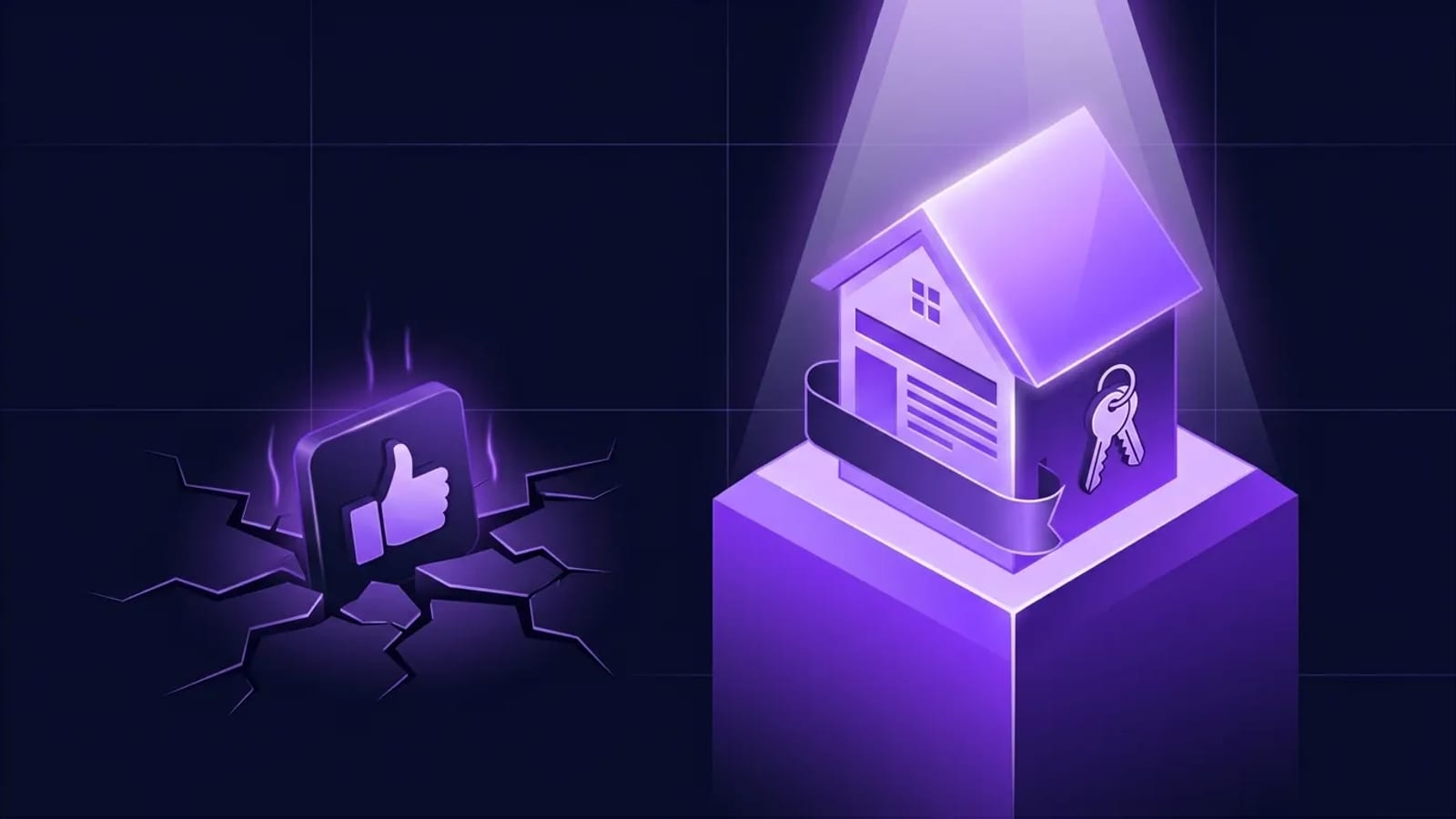
"I have a Facebook page, an Instagram account, and WhatsApp Business — why would my company need a website?" We hear this almost every week from business owners in Cairo, Riyadh, and Jeddah, and it is a fair question. The page is free, your audience is there, and the ads work. So why is a Facebook page not enough? The short answer: a page is rented land owned by a company that sets the rules and changes them at will, while a website is a digital asset your business owns and builds on for years.
This article is not a case against social media — quite the opposite. We will walk through the difference between a website and a Facebook page from the owner's point of view: what happens to your reach when the algorithm changes, why people searching on Google cannot find you, what a suspended or hacked account means for your business, why large companies want a website before they deal with you, and where selling through WhatsApp alone hits its ceiling.
Then we get practical: what a website adds, when a single landing page is enough, how to make social media and the website work together, and the first steps if you start today. At Jad Digital we have built websites and landing pages for companies in Egypt and Saudi Arabia since 2019, and what follows is what we see repeat with almost every client.
Rented land vs. an asset you own
Imagine opening a shop in a large mall in Nasr City. Foot traffic is excellent and rent is free, but the mall's management can move your shop, reduce how many people walk past it, close it without explanation, or charge anyone who wants to reach it. That is exactly the position of a Facebook page: a free and useful presence, but not yours.
A website is the shop you own on your own land. The domain is in your company's name, the content sits on your hosting, customer data lives in your database, and nobody can change the rules on you. Everything you invest in it — content, pages, Google rankings — accumulates instead of evaporating with the next platform update.
The difference is not theoretical. A company that built its entire presence on one platform discovers the size of the risk at the wrong moment: when reach declines or the account is closed. A company that owns a website uses the platforms as channels into its digital asset, not as a substitute for it.
Reach declines and the algorithm decides who sees you
Anyone who has managed a company page in recent years has noticed the same thing: a post reaches only a small fraction of the page's followers. This is not your fault. The platforms prioritise content from friends and family and whatever keeps users in the app longest, leaving business pages one clear path to reach: paid advertising.
The result is that the followers you gathered with effort and money are no longer really "yours". You pay to reach them again in every campaign, and the cost rises as the platform fills with advertisers. No algorithm decides who sees your website's services page; whoever opens it sees all of it, and whoever leaves a number in a contact form becomes a lead whose data you own and can reach without an intermediary.
The practical conclusion: social media is excellent for attracting attention, but attention not converted into an asset you own — a visit to your website, a record in your system — disappears with the next algorithm change.
A Facebook page does not appear on Google when a customer searches for you
This is the biggest gap. When someone in Cairo searches for "central air conditioning company in New Cairo", or someone in Riyadh for "commercial law firm in Riyadh", they search on Google, not Facebook. Google shows company websites, map listings, and articles; Facebook and Instagram posts rarely appear, and when they do they are not ranked for the keywords your customer types.
That means everyone searching for your service with buying intent — the most valuable customers of all, because they came looking — finds the competitors who own websites and does not find you. A page reaches people scrolling aimlessly; a website reaches people searching with a goal.
A website is also the only way to build a search presence that compounds. One article answering a question your customers ask can bring free visits for years, while a social post lives for hours. We explain how Google visibility works in plain business language in our SEO guide for business owners, and what it takes technically in our SEO services.
Suspensions and hacks: what happens to your business in a single day?
The story repeats in different forms. A page several years old, with tens of thousands of followers and every customer conversation, is restricted or closed because of a malicious report, an unintended breach of an ad policy, or a hack of the admin's personal account. The appeal goes through automated forms, can take weeks, and may never be answered. Every one of those days, your business has no storefront.
The problem is not the probability — it may be small — but the size of the loss: everything, at once. A website distributes the risk. Even if your page goes down, the domain keeps working, the phone number, WhatsApp, catalog, and forms remain available, and your customer base sits in your own system rather than in an inbox you can no longer open.
Ask yourself: if my page were closed tomorrow morning, how would a new customer find me, and how would I reach existing ones? If the answer is not ready, that is the first reason a Facebook page is not enough.
Credibility with large companies and tenders
In business-to-business dealings — a very active field in Cairo and Riyadh — the first thing a procurement manager does on receiving your offer is search your company name on Google. A clear website with services, past work, the team, an address, and official contact details passes the first test. A Facebook page alone usually sends them to the next supplier, however good your work is.
In many cases it becomes an explicit requirement: supplier registration with large corporates and government entities, tender submissions, business banking and financing, international partners, and even attracting qualified employees all require an email address on the company's domain and a website that can be cited in official documents. In Saudi Arabia specifically, as Vision 2030 pushes procurement toward digital platforms, a professional website has become a basic signal that a company is serious.
A website tells your customer what a page cannot: this is a real company, with an address, a registration, and a team, and it plans to stay.
The limits of selling through WhatsApp alone
WhatsApp is a superb tool for closing deals and serving customers, and we will keep recommending it. But relying on it as the only sales channel quickly caps growth. Every inquiry needs a person to reply manually, send photos and prices, and repeat the same answers dozens of times a day. Outside working hours, selling stops, and as orders grow you need extra staff just to answer.
More dangerously, customer data accumulates in employees' phones rather than in the company's system, and when an employee leaves, their conversations leave with them. You also cannot answer basic questions: how many inquiries came in this month? From which source? How many turned into sales? A website with a contact form and a customer management system answers these automatically and turns WhatsApp into the closing step rather than the starting point. To see what that looks like in practice, read what a CRM system is and why your company needs one.
What a website actually adds to your company
A website is not "a brochure on the internet". Built properly, it becomes a daily operating tool:
Most importantly, all of these tools work together and accumulate their data in one place you own. See our web development service for how these layers are built gradually by stage.
- Google visibility — service pages and articles that bring people searching with buying intent, free, for years.
- Lead forms — structured inquiries that land in your inbox and system instead of scattered messages.
- A catalog or service list — photos, specifications, and FAQs that save hours of repetitive replies.
- Booking and appointments — for clinics, salons, and consultancies: the customer books at any hour.
- Online payments — deposits and subscriptions collected directly by card and local wallets.
- Analytics — who visited, from where, what they read, where they stopped, and what turned them into a customer.
- Retargeting — your visitors become an audience you can reach later with precise, cheaper advertising.
- Email on your company domain — an official address that raises trust in every message.
When is a landing page enough, and when do you need a full website?
Not every company needs a twenty-page website from day one. Our rule is simple.
A single landing page is enough when:
A well-built landing page — clear headline, social proof, FAQs, a form or WhatsApp button, fast loading — converts far better than sending ads to a Facebook page. See what we build in our landing pages service.
- You offer one service or one product to a defined audience.
- Your main goal is converting ad traffic (Snapchat, TikTok, Facebook, Google) into inquiries.
- You want to launch within days and test the market before a larger investment.
- You need an official page for a seasonal campaign or a specific offer.
A full website is necessary when:
The common mistake is starting the wrong way round: a huge website with no content, or a landing page for a company with ten services. Start with what serves your current goal and expand. And if you are also considering an app, our article app or website — where should your company start? sets out the right order.
- You offer several services or product lines to different audiences.
- You want to appear on Google for dozens of keywords, which requires multiple pages and articles.
- You deal with companies that expect a professional site with detailed content.
- You need booking, payments, customer accounts, or integration with your systems.
How to make social media and the website work together
The goal is not to abandon Facebook, Instagram, or TikTok, but to reassign the roles: platforms attract attention and build the relationship; the website converts attention into an asset and closes the sale. In practice:
Arranged this way, every pound or riyal spent on social media accumulates in an asset you own, rather than paying monthly rent on someone else's land.
- Put the website link in every profile and important post, and send ads to landing pages rather than to the page itself.
- Turn every question that repeats in your inbox into a page or article, then share it on the platforms.
- Install tracking on the website so every visitor becomes an audience you can retarget.
- Collect lead data in your own system (a form, a mailing list, a CRM), not only in the message inbox.
- Make WhatsApp the closing step: from the website into the conversation, not from the conversation into nothing.
First steps: how to start without complication
If you are convinced your company needs a website, do not begin by searching for "the cheapest website". Begin here:
At Jad Digital every project begins with a free consultation in which we define the goal and the type of site that fits your stage, followed by a written proposal with a fixed scope and timeline; at handover you own the domain, the code, and every account. The aim is always the same: your company owns its digital asset instead of renting.
- Register the domain in your company's name today — even before building the site. Registering it under the company's account rather than a vendor's or an employee's protects you later.
- Define the website's first goal — inquiries? bookings? sales? corporate credibility? The goal determines the type and size.
- Gather the content you already have — a vector logo, real photos of your work, a company profile, the service list, and the questions customers keep asking.
- Ask for a written proposal with a clear scope — what is included, what is excluded, who owns the code and accounts. Our article on website design cost in Egypt explains the factors that determine the number and how to compare proposals fairly.
- Choose a partner who understands your market — in Cairo, or in Riyadh and Jeddah. See our guide to choosing the best software company in Egypt for the questions that reveal the difference before signing, and our guide to choosing a web design company in Cairo for a local shortlist.
- Launch fast, then improve — a strong landing page today beats a perfect site in six months.
Frequently Asked Questions
Do I need a website for my company if my Facebook page already brings customers?
+
Yes, because the customers the page brings depend on an algorithm and advertising you do not control, and people searching for your service on Google will not find you. The website does not replace the page; it insures your business against declining reach or a closed account and adds customers who search with buying intent.
What is the difference between a website and a Facebook page in terms of ownership?
+
A page is rented space governed by the platform's policies; it can be restricted or closed without explanation, and your followers' data is not yours. A website is a domain, hosting, and a database in your company's name — you own its content and customers and control it completely.
Is a single landing page enough instead of a full website?
+
It is enough if you offer one service or product and want to convert ad traffic into inquiries quickly. If you have several services, want to rank on Google for many keywords, or need booking, payments, and accounts, a full website is the right choice.
How does my website appear on Google when my page does not?
+
Because Google indexes website pages and ranks them for the words users type, while social posts are rarely ranked for those words. A website with clear service pages and articles that answer customer questions brings free visits that compound over time.
Should I stop using WhatsApp and Facebook after launching the website?
+
Not at all. Attract attention on the platforms, send visitors to your website where their data is captured and results are measured, then close the sale on WhatsApp. The website is the hub; the platforms are channels that feed it.